Wicker’s Liminal Undeath
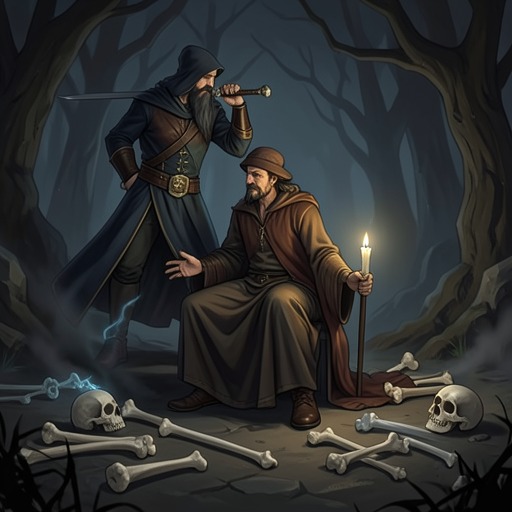
The Reincarnated Demon King's Host Just Wants to Live in Peace, But the Hero Won't Leave Him AloneWicker’s Liminal Undeath is a condition in which necromantic magic keeps its bearer existing after death, but does not return them to ordinary life or preserve their body intact. Wicker describes the result as an unfinished passage between life and death: their heartbeat is gone, their hands have been lost, and their continued existence depends on magic that will last only until there is nothing left to take.
Nature of the Condition
Wicker explains that they are a necromancer whose magic takes a part of them when they die, allowing them to keep living. They resist a simple classification as either alive or undead: they say they are not truly undead, but not fully alive again either. Their state is therefore not a restoration to the life they had before, but a continuation marked by absence and attrition.
The condition has a limit. Wicker says that the magic sustains them until there is nothing left. Their account does not describe a cure, a reversal, or a way to replenish what has been taken; it presents continued existence as contingent on the remains of the person and the magic that holds them there. The phrase makes their survival sound less like invulnerability than an unfinished process with an endpoint, even as other people regard them as someone who cannot die.
Bodily History and Visible Signs
Theo identifies the first sign others have missed: Wicker has no heartbeat. The realization comes during a journey, after Theo asks whether their long travels began while they were alive or only afterward. The others react with shock, and Avery closes a hand around magic as he asks whether Wicker is undead. Wicker laughs at Theo’s perception, recognizing that a healer would notice what the rest of the group had overlooked.
Wicker then makes the condition visible. They remove one glove to reveal bare white bone where their hand should be. They explain that their heartbeat was the first thing to go. They had been a sickly youngling who was not expected to live long; later, people trying to kill them took their hands, one after the other. Wicker remarks that, in a sense, those attackers succeeded. The sequence gives the loss a history: the absent heartbeat and missing hands are not merely signs of an unusual body, but stages in a life repeatedly subjected to illness and violence.
Their masked face is not evidence that they have lost it. When Luc asks whether the mask conceals such a loss, Wicker says their face remains, while acknowledging scars elsewhere. They add that some people find it entertaining to torture someone they believe cannot die. The mask thus belongs to a body with injuries and a history of mistreatment, but the evidence does not identify it as a disguise for a missing face. Wicker’s matter-of-fact manner makes the disclosure especially stark: they recount both bodily loss and torture without turning either into a demand for pity.
Disclosure and Relationships
The revelation changes how the traveling party sees Wicker, but it does not begin with suspicion from everyone. Cargo says he had already told the others they could trust Wicker, while insisting that trust did not entitle him to disclose their secret. His silence makes the distinction between knowing and exposing explicit: he has recognized Wicker’s concealed condition without treating it as his information to share. Theo, by contrast, notices the missing heartbeat and asks directly, prompting Wicker to explain their history in their own terms.
Avery’s first response is alarm, expressed through the magic gathering around his fist and his question about whether Wicker is undead. Luc’s response to the mask is gentler; Theo is relieved to hear pity rather than anger in his tone. When Wicker exposes their hand, Theo presses an arm against their shoulder, understanding that Wicker uses touch to show affection. Theo also considers that the contact may offer the warmth of the living as a reminder, though this is presented as his interpretation rather than something Wicker confirms. Bryony joins them on the other side and offers comfort. The scene answers bodily difference and uncertainty not with a cure or a verdict, but with touch and company.
Agency and the Story’s Treatment of Death
Wicker’s condition does not reduce them to an object of revelation or to a passive survivor. During the later encounter with a Nested ghost, they take an active role in the effort to stop it: they throw a lantern at its feet, use a rune to ignite a torch, and attack the creature as its oil-soaked flesh catches fire. Their actions show a necromancer with practical magical skill, acting alongside the others despite the losses they have described. The Nested ghost’s destruction does not restore Wicker’s body or settle the question of their own state; the episode instead places their knowledge and agency beside another being caught in a terrible relation to death.
The contrast with Leafel’s funeral customs sharpens the difference between a death that can be ritually mourned and Wicker’s unsettled continuation. Most burials are bonfires intended to release the departed soul, while Glefald chooses burial in the earth beneath a tree that will feed new life. Wicker’s account offers no comparable clear passage: their magic keeps them going, but only in a state they describe as neither fully alive nor truly undead. Read together, these details make their condition a sustained boundary rather than a completed return. Yet the party’s response also prevents that boundary from defining all of Wicker’s relationships. Their missing heartbeat and skeletal hand are recognized; so, too, are their trustworthiness, affection, skill, and right to decide when their story is told.